5 Best Winter Camping Tent

Best winter camping tent. How can you pick the Best Winter Camping Tent for you when there are so many companies making such a broad range of goods, each with its own attributes and types of products?
When compared to summer camping, winter camping calls for a whole different set of supplies. You’ll need a lot of gear, but a winter tent that can withstand the weather is essential. High winds, heavy rain, snow, and condensation management are all factors in the construction of cold-weather tents. A three-season hiking tent may be adequate in milder winter circumstances, but in harsher environments, a cold-weather tent should be used instead.
Choosing a winter tent that is appropriate for the weather and the kind of camping you’ll be doing may be challenging, as is the case with other camping gear. Many varieties of cold-weather tents exist, each one optimized for a certain wintry camping situation.
This collection of some of the finest cold-weather tents will have you covered, whether you need a tent for a few nights of high altitude climbing or a week of wilderness life deep in the backwoods. Read on for more details on each style of winter tent, and have a look at what you may choose from.
Contents
Our Top Picks:
- Best Overall: AYAMAYA 4 Season Backpacking Tent
- Runner-up: Naturehike Cloud-Up 2 and 3 Person
- Top Choice: Playdo 4-Season Waterproof Cotton Canvas Bell Tent
- Highest Quality: WHITEDUCK Regatta Canvas Bell Tent
- Best Compact: ALPS Mountaineering Tasmanian 2-Person Tent
5 Best Winter Camping Tents
1. AYAMAYA 4 Season Backpacking Tent 

The tent comprises a 3000MM waterproof PU-Coated 210D oxford groundsheet, 2000MM waterproof 190T polyester fabric roof, 190T polyester breathable inner wall, and wide B3 no-see-um mesh wall Heat-sealed seams keep you dry inside. Tent weighs 5.7lbs with 7.9mm 7001 aluminum pole.
Two vestibules store camping items in this tent. Tent dimensions: 86.6in/7.2ft long, 55.1in/4.6ft wide, 47.2in/3.9ft high. Perfect for solo or couple campers. This tent features two d-shaped openings for convenient ingress and ventilation. The inner tent wall has breathable material below and B3 mesh above, with big mesh windows at the entrances for ventilation. Two top vents on the outer rainfly decrease condensation and promote comfort.
This camping tent assembles easy. The pre-attached automated setup aluminum pole and robust inner tent clips allow tent setup and breakdown in under 2 minutes. The freestanding tent may be moved without disassembly. It’s simple.
This hiking tent comprises a rainfly and inside tent. The inner and exterior layers create a windproof, waterproof hiking tent. A ventilated tent might be the inner layer. An outer layer may shade itself. Backpacking, hiking, adventures, fishing, kayaking, camping, motorcycling, bikepacking, etc.
Feature
- Product Dimensions 83.6″L x 57″W x 49″H
- Material Polyester
- Item Weight 5.7 Pounds
- ASIN B08CXDXZH5
Pros
- Has a snow skirt
- It has a double-wall structure.
- Spacious
Cons
- No equipment mezzanine or storage compartments
- confined color choices
2. Naturehike Cloud-Up 2 and 3 Person Lightweight Backpacking Tent
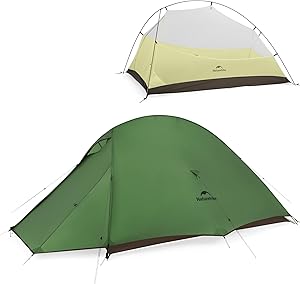
There are a few necessities for a tent in the event of being stuck outdoors during a snowfall. Fortunately, your needs may be met by the Naturehike Cloud-Up Lightweight Tent. You may choose between a 2-person and 3-person version of this lightweight hiking tent, which weighs in at little over 4 pounds.
This tent’s adaptability stems in part from its anti-scratch mesh inner tent and its removable rain flap. It’s not a seasonal tent that can only be used in the winter. Putting up the silicone-coated nylon rain flap provides additional insulation.
This tent includes a snow skirt on the outer fly in addition to the double-walled construction that protects you from the elements. This protects the inside tent from becoming wet or chilly by deflecting snow away from it. The vestibule is the third practical addition to this tent. This way, you may keep your boots and equipment in a dry, ice-free space outside the tent.
Feature
- Product Dimensions 15.75″L x 5.12″W x 5.12″H
- Material Nylon, Aluminum
- Weight of Item: 1.8 Kilograms
- ASIN B07HT5XD9D
Pros
- It sports a snow skirt.
- It is double-walled.
- There is a vestibule.
Cons
- No cargo storage
- Unique vestibule
3. Playdo 4-Season Waterproof Cotton Canvas Bell Ten

This lightweight one-person, three-season tent weighs 1.96 kg. Despite its lighter look than mountaineering and winter hiking tents, this Seek Outside Tipi can endure severe winds if set up correctly. This is a wonderful wilderness base camp tent since it can fit a stove, sleeps two (four without the stove), and just needs a tent footprint (not supplied).
Ultralight silicone in its thin structure makes the nylon 30D fly 3000mm waterproof. It’s one carbon pole may look unstable, but the tent’s shape and guy-outs make it storm-proof. Tent height is 6 feet, 10 inches, floor space is 115 square feet, and stove port features vents to prevent condensation.
Feature
- Product Dimensions 196.85″L x 196.85″W x 118.11″H
- Material Cotton
- Unique Characteristic Waterproof
- ASIN B076DXBSWM
Pros
- Incredibly spacious and opulent
- Stable in adversity
- Includes a cooktop inlet
Cons
- Very weighty
- Only suitable for automobile camping
4. WHITEDUCK Regatta Canvas Bell Tent


Hot tents, which are tents with space for a wood burner, are often seen in the shape of a bell tent. A bell tent, even in the dead of winter, exudes an air of enchantment. Living in a bell tent is like stepping back in time. However, bell tents have many useful features, particularly when it comes to keeping warm in the winter.
When it comes to heated tents for camping in the winter, nothing beats the Whiteduck Regatta Canvas Bell Tent. The stove pipe hole is heat-resistant, so you may use a tent stove even if the tent itself is roomy. This allows you to prepare basic meals and drinks inside your tent.
Whiteduck employs waterproof and UV-resistant army duck fabric in its products. Warmth from a wood-burning tent heater will make you forget about the cold weather outside the tent’s sturdy canvas walls.
Feature
- Dimensions of the item are 96 x 96 x 62 inches
- Weight of Item: 8.5 Ounces
- Material Cotton
- ASIN B07MZQ7BH2
Pros
- Spacious
- Very toasty with the fireplace
- Durable canvas outer
Cons
- Expensive
- Not built to withstand massive snow accumulation
- Heavy
5. ALPS Mountaineering Tasmanian 2-Person Tent

The ALPS Mountaineering Tasmanian 2 is a great entry-level winter camping tent because of its low price and high quality, thanks to its two entrances and two vestibules and 8 square feet more floor area than the Arete. It’s a little heavier than its rivals, but it’s no problem at all for two people to carry.
Because of the unconventional arrangement of the tent’s poles, there is plenty of headroom inside, and the tent is very stable even when the wind is gusting and the sides are steep. The Tasmanian 2 has a strong 75D polyester fly, making it somewhat more winter-ready than the Arete.
Feature
- Product Dimensions 92″L x 62″W x 46″H
- Material : Polyester, Aluminum
- Weight of Item: 7.9 Pounds
- ASIN B09SJ3KMLF
Pros
- Stable in extreme winds
- Two anterooms
- Superior living space
Cons
- It is heavier than its rivals.
Buyer’s Guide
A word of caution before we get into the specifics: the finest winter tents include a lot of technical language and special features that you may not be acquainted with. To make sure we’re on the same page, here’s a brief primer. Check out our buyer’s guide for further information.
Tent for all four seasons
This is the proper nomenclature for tents used in the colder months of the year. While all four-season tents can withstand temperatures below freezing and light snowfall, some are more robust than others and can withstand winds of up to 70 miles per hour and several feet of snow.
Tent with one wall
Single-layer tents, as the name suggests, lack the traditional canopy and rainfly systems seen in three-season camping and backpacking tents. While single-wall tents have the advantages of being lightweight, compact, and simple to put up, they often lack the ventilation of double-wall tents.
Two-layer tent
Many winter tents are double-walled, like the tents used for camping and trekking, but they don’t include mesh netting. These tents are bulkier than the single-wall types mentioned above, but they usually have greater ventilation, are more spacious, and have more convenient features and storage than their lighter counterparts.
Building a Pole
Keep in mind that fiberglass poles are strictly forbidden in winter tents, aluminum poles may be used if they are made for low temperatures, and the investment in flexible carbon composites is well worth it.
Gauge of the fabric
A fabric’s thickness directly correlates to its durability and thermal insulation. Knowing that a tent with a “20D” rainfly and another with a “30D” rainfly of the same material should have the longer lifetime is easy enough, since fabric thickness is noted in “denier” or “D” grades.
Textile finishes
Winter tent fabric treatments boost water resistance. PU, silnylon, and DWR are the most common. Polyurea coating is the most popular and affordable. They won’t last as long as silnylon, but they’ll last. Silnylon fabrics cost more but last longer and weigh less. Any tent material may have DWR coatings added as a bonus.
Best Winter Camping Tent: Testing and Methodology
To identify the best winter camping tent, we rigorously tested over a dozen 4-season tents in some of the most challenging environments. This included snowy alpine campsites, exposed ridgelines, and high-altitude basecamps. Over an extensive 60 nights and 400 miles in the backcountry, we assessed each tent on six critical metrics:
- Weather Resistance: How well does the tent withstand harsh winter conditions?
- Weight and Packability: Is the tent lightweight and easy to transport?
- Interior Comfort: Does the tent provide adequate space and comfort for campers?
- Ease of Setup: How simple is it to pitch the tent in a winter setting?
- Durability: Can the tent endure the wear and tear of winter adventures?
- Versatility: Is the tent suitable for both winter and shoulder-season camping?
Our mission was to pinpoint the top-performing shelters that excel in winter camping scenarios, catering to the diverse needs of all types of campers seeking reliable protection during their outdoor escapades.
Why Trust Surviving Guide for the Best Winter Camping Tent
At Surviving Guide, we are dedicated to providing you with the best winter camping tent recommendations based on extensive hands-on testing and in-depth expertise in outdoor gear. Our passionate team, composed of seasoned adventurers, rigorously evaluates each product under real-world conditions. Together, we’ve traversed thousands of miles across a variety of terrains, from the rugged peaks of the Rockies to remote alpine campsites.
Leading our assessments is Ben Dawson, our expert on 4-season tents, who brings over 200 nights of cold-weather camping experience, including multi-day ski tours in sub-zero temperatures. As an accomplished guidebook author, full-time traveler, and father of two, Ben’s love for outdoor adventure has evolved into a mission to teach the next generation about the joys and challenges of backcountry exploration.
With his extensive experience navigating alpine environments and evaluating gear in challenging conditions, Ben ensures that every winter camping tent recommendation is rooted in real-world expertise, helping you choose the best gear for your next cold-weather adventure.
FAQs:
Q. In a frigid climate, what kind of tent would you recommend?
A compact, double-walled tent is perfect for freezing weather. An uninsulated single-wall tent may not keep you warm. It should be tiny so your body heat can rapidly warm the tent and the double walls can contain it. If you’re not camping or hiking, a canvas tent with a wood fire is another great option for staying warm in extreme cold.
Q. Should you invest in a winter tent?
The cold is more than just an annoyance; it may really be harmful. Having a winter tent will not only increase your comfort and safety if you want to go camping when the temperature drops below freezing or there is snow on the ground.
However, not all high-quality winter tents are prohibitively pricey. There are several excellent tents on our list that are cheaper than $100 and have a remarkable cold-fighting design. It’s always a good idea to take precautions, but you don’t have to go into debt just to remain warm.
Q. Can you keep warm in a tent in the winter?
With the appropriate configuration, you can sleep comfortably for hours. Winter tents need a little more investment than summer tents due to the need for insulation. A winter tent, the right clothes to sleep in, and maybe even a small wood heater can keep you warm and safe all night long.
Q. How chilly must it get before a tent becomes unbearable?
Be careful below 40 degrees Fahrenheit. Winter camping may cause hypothermia. Danger increases with colder temperatures. Expect 30 degrees Fahrenheit. Subfreezing conditions make even a 3-season tent inadequate. Choose a windproof, waterproof, and stable choice.
See more: